
Home / Labneh: Taste, Texture & Serving Choices

Labneh is yogurt strained until it’s thick enough to spread. It’s tangy and slightly salty with a texture that’s somewhere between Greek yogurt and cream cheese.
At Effy’s Café (a kosher, meatless Mediterranean café in Manhattan), it’s a starter, and it’s on the Middle Eastern breakfast menu.
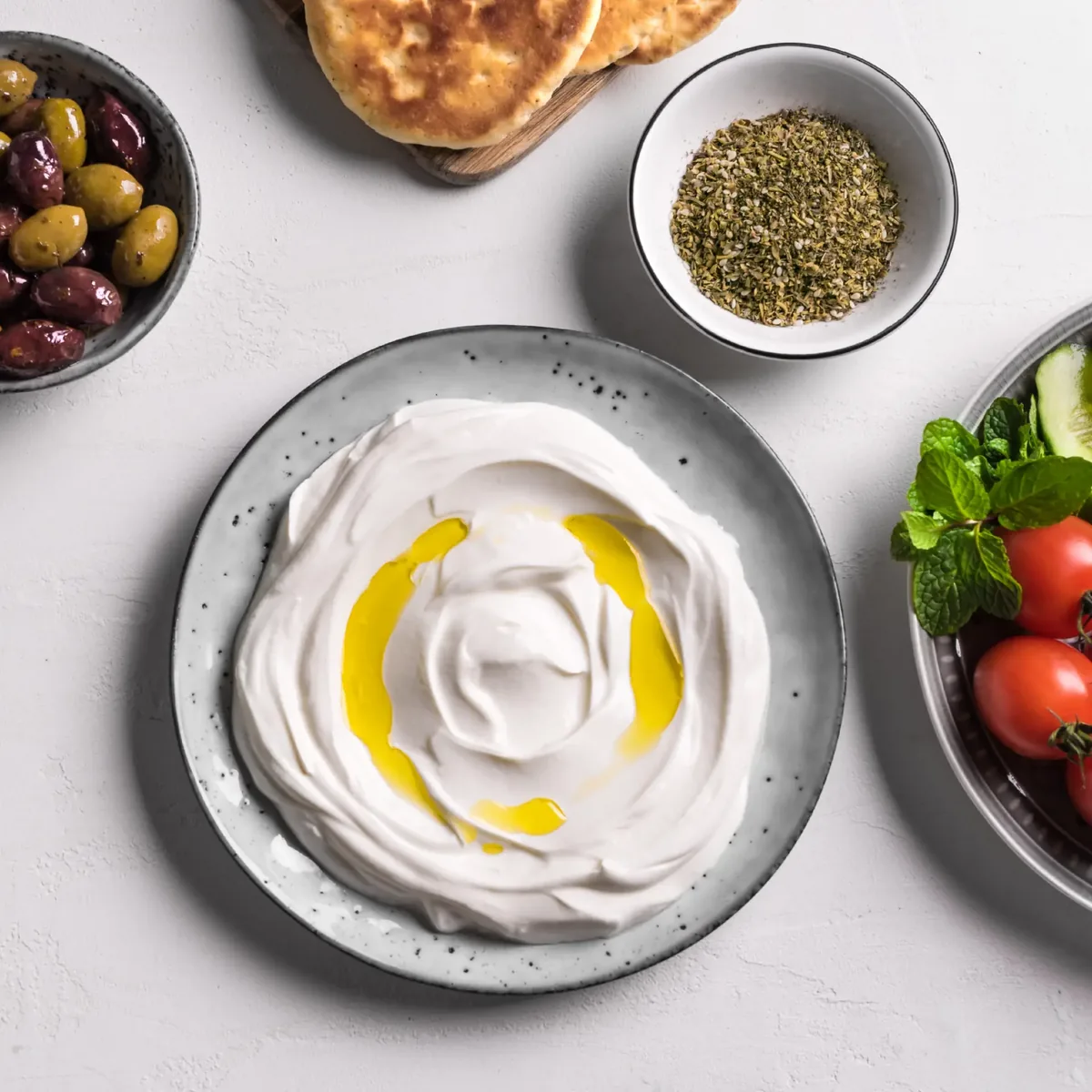
Labneh is a thick, creamy dairy product that’s essentially plain yogurt, salted and then strained to remove the vast majority of the whey (the liquid). The result is a smooth, creamy spread with a very distinct tang.
It’s a fundamental part of Middle Eastern and Levantine cuisine, usually eaten at breakfast or as part of a mezze. You’ll quite commonly find it as part of a mezze tray with the fresh veg, the bread, and all the other little plates.
Although it starts as yogurt, labneh has the texture of a soft cheese and is therefore often described as ‘yogurt cheese’ even though it’s not actually made the same way.
Labneh is just yogurt and salt.
Most traditional versions start with whole-milk yogurt, though some variants use goat’s milk yogurt, which gives the final product a different flavor.
The salted yogurt is left to drain through the cloth for several hours until most of the whey has separated out from the thicker dairy solids. The end product is a rich, spreadable yogurt.
Labneh is in fact a type of strained yogurt, though it’s generally classed with the fresh cheeses due to its texture.
Unlike a lot of the traditional cheeses, labneh doesn’t need rennet or any aging. The thick texture comes from the removal of the whey from the yogurt.
It can be spread on bread, used as a dip, or topped with herbs in the same way as other fresh cheeses.
On a Middle Eastern breakfast plate, it could easily sit alongside feta or halloumi.
Labneh is tangy and lightly salty with a rich dairy flavor. It’s tangier than cream cheese, but the tang is familiar to anyone who’s ever had plain yogurt.
The exact flavor will, of course, depend in part on the milk that you use. Labneh made from goat’s milk yogurt, for instance, can be much sharper than the version made from cow’s milk.
A drizzle of olive oil adds a fruity note to counteract the tartness. Za’atar (the traditional Middle Eastern herb blend of herbs, toasted sesame, and sumac) adds an earthy note, along with fresh mint and cucumber for freshness.
You can also use it in sweet dishes. At Effy’s on Columbus Avenue, the Strawberry Labneh Milkshake is labneh with strawberry, honey, and vanilla – a completely different way of experiencing the distinctive tang of the labneh beyond the more conventional savory combinations.

Labneh is thick, smooth, and spreadable. It’s firm enough to hold a swirl in a bowl and yet soft enough to scoop up with a piece of bread.
Compared to Greek yogurt, it’s much denser and far less likely to run off the spoon. It has the consistency of softened cream cheese, though it has a quite different flavor.
The longer you let the yogurt drain, the firmer the resulting labneh will be. Some will be soft enough to use as a dip; others will be much more substantial.
Here’s how labneh compares with two other well-known dairy products.
| Labneh | Greek Yogurt | Cream Cheese | |
|---|---|---|---|
| Made From | Salted yogurt, strained until spreadable | Yogurt strained for a shorter time | Milk and cream |
| Texture | Thick, smooth and spreadable | Thick but spoonable | Dense and smooth |
| Taste | Tangy and lightly salty | Tangy, usually unsalted | Mild and less tangy |
| Usually Eaten | As a dip or spread with olive oil and bread | With a spoon, often with fruit or honey | On bagels and toast |
No, though labneh and Greek yogurt are very much related. Both are made by straining yogurt, but labneh is generally the thicker and saltier of the two.
Greek yogurt is still spoonable and is typically eaten plain or with sweet toppings. Labneh, on the other hand, is more often used in savory dishes because of its firmer texture and distinctive salty flavor.
Many home cooks will start with Greek yogurt when making labneh, which is one of the reasons why the two are so often confused.
Yes, absolutely in terms of texture. Both are smooth, thick spreads that you can use on bread or as a base for toppings.
The biggest difference is the flavor. Cream cheese (made from milk and cream) is generally quite mild. Labneh, on the other hand, has a more pronounced tang and a very slight saltiness.
If you’re a fan of cream cheese on toast or a bagel, then labneh is a good alternative (it’s a bit sharper). It works with a lot of the same things.


Labneh is excellent with warm pita, other breads, fresh veg, and olive oil. Herbs like za’atar and mint also pair well.
Since it works as a dip or spread, you can enjoy it in ways that go well beyond the traditional breakfast plate.
Some familiar pairings include:
If you’re wondering what’s good with labneh, the easiest place to start is bread and olive oil. From there, you can pair it with all sorts of other things depending on the meal.
Labneh for breakfast is a real thing across the Middle East. It’s traditionally spread on bread with some olive oil or served with the eggs and fresh veg.
Its savory nature makes it ideal for the morning when you’re not in the mood for a sweet yogurt dessert.
A typical labneh breakfast is one where you’ll have a bit of the labneh with each bite of your bread or egg. It’s also completely hands-off, so it’s easy to add to your breakfast.
At Effy’s Café, the Middle Eastern Breakfast is on the menu with labneh served with the eggs and pita.
As a dip, labneh is traditionally spread out in a shallow bowl with a pool of olive oil in the middle. Then sprinkle za’atar or mint on top, and serve pita and some cut veg to scoop up.
This is the classic way of eating Mediterranean labneh as part of a mezze platter (with hummus and babaganoush, etc.).
As a spread, it’s great on toast, bagels, and in sandwiches where you’d normally use cream cheese.
A firmer version is also known as labneh balls. These are labneh drained until firm enough to shape into little balls, usually kept in olive oil.
Labneh is a simple addition to a meat-free meal based around small plates. For other ideas on vegetarian café dishes, have a browse.
Labneh is LAHB-neh (two syllables, stress on the first). Some people say the second syllable is ‘nay’, making it LAHB-nay.
Yes. Labne, lebneh, labneh, and labaneh are just different English spellings of the same Arabic word for strained yogurt. Different menus will obviously use different spellings, but they’re all the same thing.
Labneh comes from the Levant (Mediterranean region), where people have eaten strained yogurt for hundreds of years. It’s now popular throughout the Middle East and is a staple on Mediterranean menus, usually served alongside hummus and falafel.
No, traditional labneh is made from dairy yogurt. Plant-based alternatives are available, made with dairy-free yogurt. Effy’s Café does have a range of vegan dishes, and the team can help you with that as well.
Za’atar adds an herbal, slightly tangy note that cuts through the richness of the labneh. It’s normally a mix of dried thyme or oregano, toasted sesame seeds, and sumac. Effy’s on Columbus Avenue serves it as Labneh and Za’atar.
Labneh is a tangy, creamy strained yogurt, thick enough to spread, and is normally eaten with bread and olive oil.
At Effy’s, you can have it as a starter or as part of the Middle Eastern breakfast. Check out the Effy’s labneh starter and the Middle Eastern breakfast menu to see how the dishes are presented.
The starter is a good option if you’re trying labneh for the first time, especially if you’re after a few small plates.
For a more substantial meal, try eggs and pita with labneh for a proper old-fashioned savory breakfast.
Labneh is a $7 starter on Effy’s menu. It’s served in both the West 96th Street and York Avenue cafes with whole wheat pita so you can easily scoop it up.
At Columbus Ave, the small plate is Labneh and Zaatar (the labneh with the zaatar).
If you’re having a small mezze meal, you could add another starter (hummus or babaganoush, for instance) to go with it.
This is a good way to have labneh without going all out on a full breakfast plate.
The Middle Eastern Breakfast is $17 at the Effy’s on West 96th Street and Columbus Avenue.
It’s two eggs with hummus, beets, labneh, house salad, and pita. At West 96th Street, the plate has feta; at Columbus Avenue, it’s halloumi.
This is the option for the diner who wants to have the labneh as part of a traditional savory breakfast (with pita to scoop it up and eggs to go with it).
Prices and menu items vary by café. You can select an Effy’s Café and go to its ordering page to see the current menu and prices.